Lo Que La Dictadura Nos Dejó
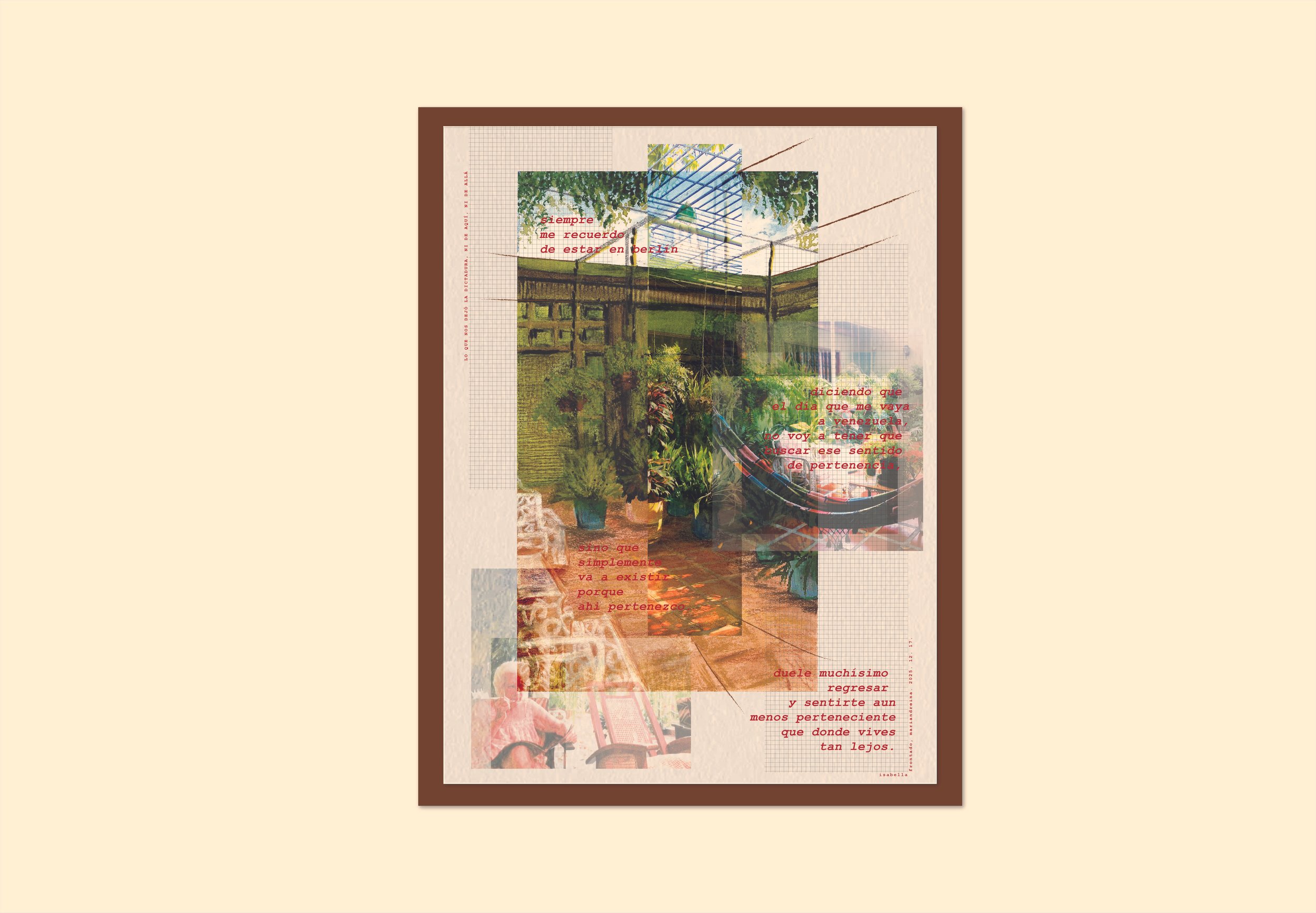
Part of an in progress series called Lo Que La Dictadura Nos Dejó (2026)
The project emerges from ongoing exchanges with my cousin Marian, who returned to Venezuela after eight years living in Berlin. Her confrontation with the reality of return echoes something I have felt throughout my life. We carry Venezuela with us in memories increasingly distorted by distance, time, and political rupture. Having lived in Venezuela and left when I was young, returning yearly throughout my childhood, I am all too familiar with the understanding that returning does not restore a place once you have left it. This series, with text overlaid from Marian Frontado, is an exploration of how we capture the reality of returning home once it, and we, has changed and how that experience and sometimes abrupt misalignment with our memory reshapes our relationship to, and understanding of, home.
Lo Que La Dictadura Nos Dejó, Ni de aquí, ni de allá (2026) Watercolor, pen, and digitally overlaid photographs on watercolor paper. 18” x 24”
Clip of roughly transcribed voice-note
... y siempre me reuerdo de estar en Berlín diciendo que el día que me vaya a Venezuela, no voy a tener que buscar ese sentido de pertenencia, sino que simplemente va a existir, porque ahí pertenezco y duele muchísimo regresar y sentirte aún menos perteneciente que donde vives tan lejos porque bueno, en Berlín llevas ocho años allá y obviamente te hiciste tu vida y buscaste la manera de pertenecer, por lo tanto buscaste a tus amigos y los elegiste tú. Eliges todo. Como te vistes y con quién estás y qué tipo de actividad haces y eso te ayuda a sentirte perteneciente, y como eso. Al final creo que a nos nosotros es necesario sentir perteneciente para poder sentirnos reconocidos, como un ser—como un ser humano.
Y ha sido bastante fuerte, de verdad, para mí regresar y sentirme… tener esa nostalgia y esa sensación tan fuerte de querer sentirlo y de decir, “guau, sólo voy a tocar esa tierrita y I’m Gonna Feel Exactly as I Want To Feel y he extrañado tanto y que haya sido en realidad todo lo contrario que no se siente para nada así, y que es completamente diferente y que en realidad no me siento perteneciente… no para nada, porque claro pues estoy en mi casa y con mi familia, pero incluso eso. Sentarme a hablar con mi papá, y que él obviamente sea la persona que siempre ha sido, pero ahora yo también soy otra y ver las diferencias abismales...
- Marian Frontado
(español)
…and I always remember being in Berlin, saying that the day I go back to Venezuela, I won’t have to search for that sense of belonging, that it will simply exist, because I belong there. And it hurts so much to return and feel even less like you belong than in the place where you live so far away. Because, well, in Berlin you’ve been there eight years, and obviously you built your life there and found a way to belong. You chose your friends and you chose them yourself. You choose everything: how you dress, who you’re with, what kind of activities you do. And that helps you feel like you belong. In the end, I think that for us it’s necessary to feel that we belong in order to feel recognized—as a being, as a human being.
And it’s been really hard, truly, for me to return and feel that… to have that nostalgia and that intense feeling of wanting to feel it, of saying, “wow, I’m just going to touch that little bit of land and I’m gonna feel exactly as I want to feel, and I’ve missed it so much,” and for it to actually be the complete opposite. That it doesn’t feel like that at all. That it’s completely different, and that I don’t actually feel like I belong. Not at all.
Because yes, of course, I’m in my house and with my family, but even that. Sitting down to talk with my dad, and him obviously being the person he’s always been, but now I’m also someone else, and seeing those huge differences…”
(english)