Originally delivered by Isabella Frontado as a Lecture for the Wellesley 150 Symposium on October 4, 2025.
I often think back to the very first time I heard the words “landscape architecture.” I was eight years old, riding to soccer practice with my friend Susannah’s mom, Trudie. Someone asked her what she did for work, and she explained that she was a landscape architect. At that age, the only thing I could really grasp was that she loved plants, made beautiful gardens, and I remember being impressed by the colorful hand-drawn plans that hung around their house. I didn’t yet have the language to understand what her work entailed, but a seed was planted. That early impression—that shaping land could be a form of artistry—never left me. What I came to realize later is that artistry in landscape is never only about plants or drawings—it’s about working within layers of geology, politics, economics, and culture, each one shaping the ground we stand on.
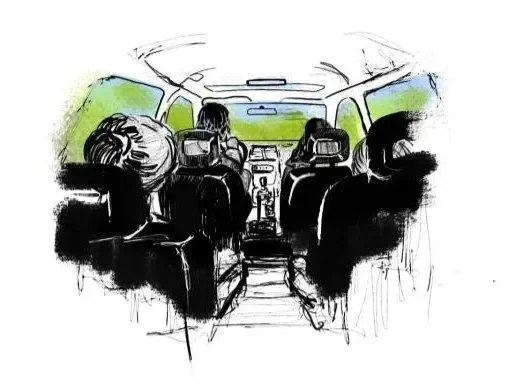
Every landscape is made of layers that reach across time and scale. As children, many of us first grasp the idea of deep time through dinosaurs or outer space—prehistoric ages lasting millions of years, or galaxies unfolding over billions. Those scales remind us how brief human histories are by comparison, yet how powerful their traces can be. Geology sets the deep foundation, shaping landforms over millennia. Politics inscribes boundaries and jurisdictions, redrawn again and again. Economics leaves its marks in patterns of settlement, industry, and neglect. Culture weaves narratives across all of it, altering what we choose to see and value.
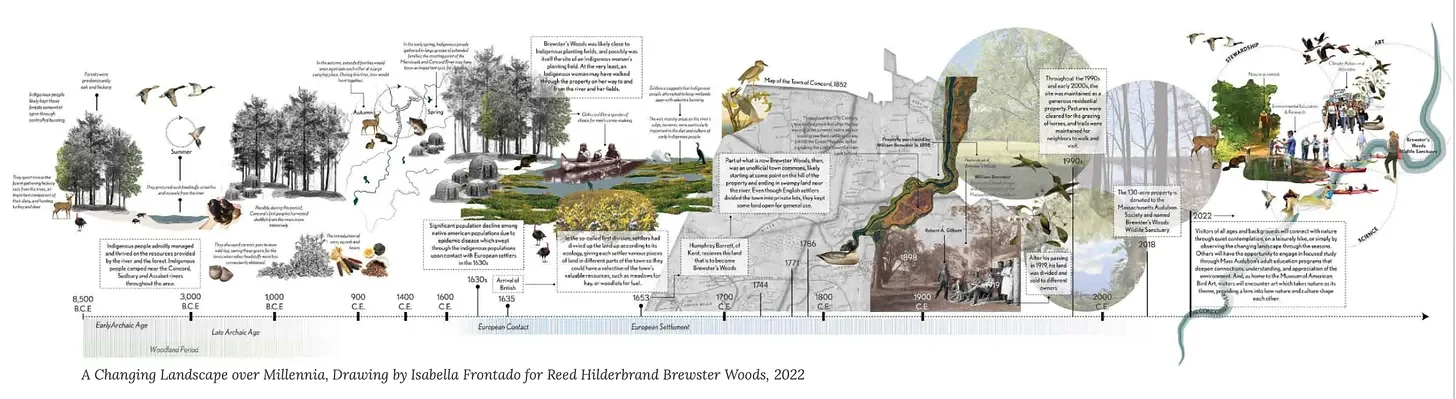
As landscape architects, we learn to toggle between these layers: sometimes reading the long timescale of a river’s morphology, other times the short timescale of landownership, a zoning change or neighborhood memory. What we design is never just of the present—to shape land is to step into an ongoing chain of stories, each one framing what it means to care for the world we inhabit.
Landscapes as Living Records
The place that truly opened my eyes to the possibilities of landscape and shaped my relationship to land, was Venezuela. Though I was born in Boston, I’m Venezuelan American. When I was a baby we moved back to Venezuela and lived there until I was about 5 years old, and between yearly visits back to see my extended family, I was raised in a Venezuelan/American household, speaking Spanish at home, cooking Venezuelan food, listening to Latin music and very much entrenched in both Venezuelan and American culture and politics. Growing up both Venezuelan and American I understood that politics was life, and political systems had the power to shape every aspect of our lives, providing opportunities and taking them away.
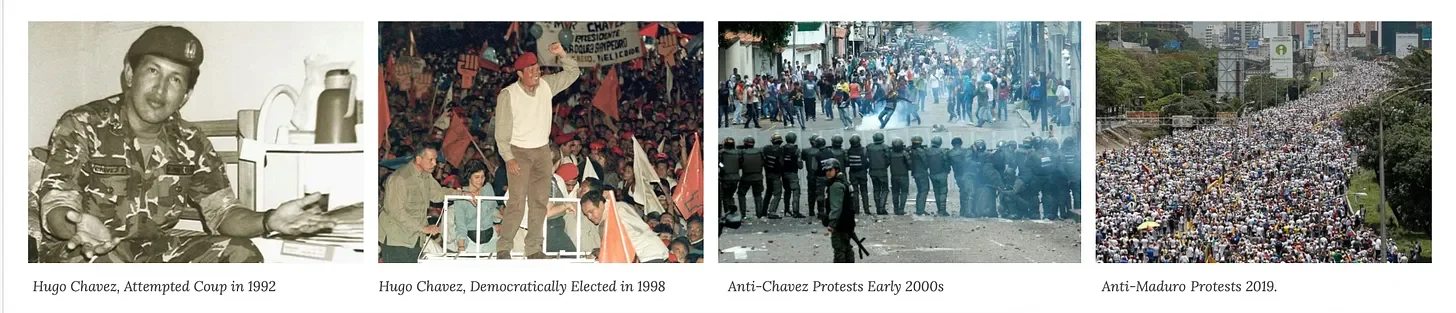
Throughout the early 2000s, as I was growing up in the United States, Venezuela, Latin America’s oldest democracy, was crumbling. My experience of Venezuela over the years was in yearly snapshots that made the rapid political shift in the country overt. Every trip began in Caracas, and we would make a long drive—ten, sometimes twelve hours—through a shifting landscape to Carúpano, the small coastal city where my grandmother lived. That drive eastward was an education in history, culture, and landscape. We traveled along a mostly two-lane highway through kaleidoscopic terrain: lush green mountains, humid jungle, broad stretches of savanna, arid red-clay desert, and finally, the radiant Caribbean Sea.
I had the incredible opportunity to watch, as over the years, with each trip the landscape, cities, and villages along the trajectory morphed—growing and shrinking against the backdrop of a seismic social, political, and economic shift in the country. It was at the scale of the year-to-year changes seen along this trajectory that I started to understand how the shape of our cities and landscapes evolved over time in reference to the complex societal pressures of our world. I was fascinated by the myriad of ways that one could choreograph that change, and harness it for good.
There is so much power in shaping land, shaping spaces, shaping cities, and doing so is inseparable from the political and economic structures that define their bounds. Every change we inscribe onto the ground—whether through policy, through infrastructure, through design—reverberates in the lives of people and can have a variety of impacts on our world.
Democracy as work
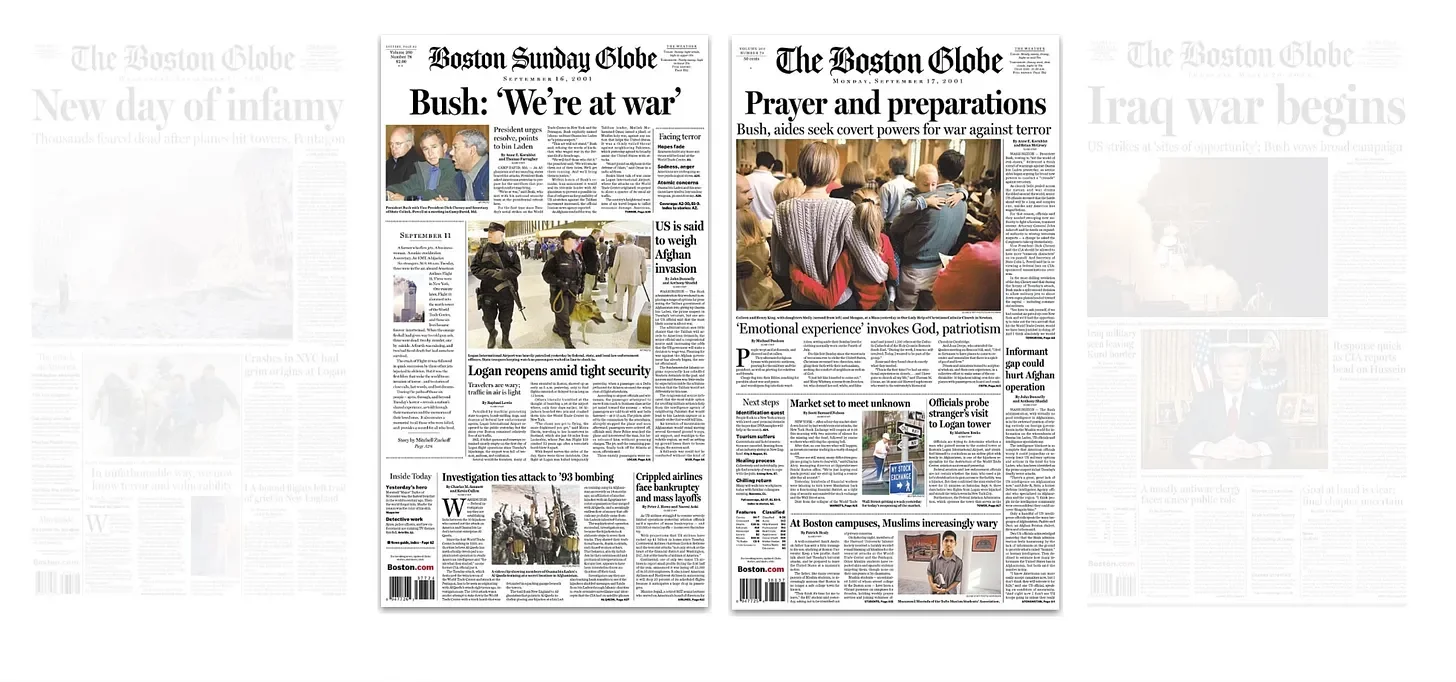
Growing up in the U.S. in the early 2000s, against the backdrop of 9/11 and the wars in Afghanistan and Iraq, I absorbed a kind of ambient patriotism—the idea that democracy was the only system that could move the world forward, and that America was its defender. There was pride in that narrative, but also a blindness: a belief in American exceptionalism that often overlooked the daily work required to sustain a democratic society, especially one as expansive and diverse as our own.
As a Venezuelan American, I carried another perspective alongside it. I knew what it looked like when institutions weakened, when a democracy faltered, when the “work” of holding a collective together was neglected for a cult leader. I understood the urgency, but as a young person, I couldn’t yet imagine how that work of preserving and building up democracy could happen here, and how I, a person interested in art and design, could contribute to it. However, it was through my design education, and later practice that I began to find that path.
Objects as Texts
In high school, my AP Art History teacher, Mr. Pollans started the semester by reading the statement in his syllabus, “Art history is the history of the world told through collections of objects.” As would unfold throughout the semester, these objects reveal early human patterns of life, the rise and fall of empires, the values not just of artists but of the wealthy and powerful who funded the creation and preservation of these objects, the trade networks that circulated them, and the agricultural and industrial practices that supplied their materials. By unpacking how these objects were made, distributed, and preserved, we gain deep insight into the forces that have shaped human history. Mr. Pollans made clear that objects were a new text that I needed to learn how to read.
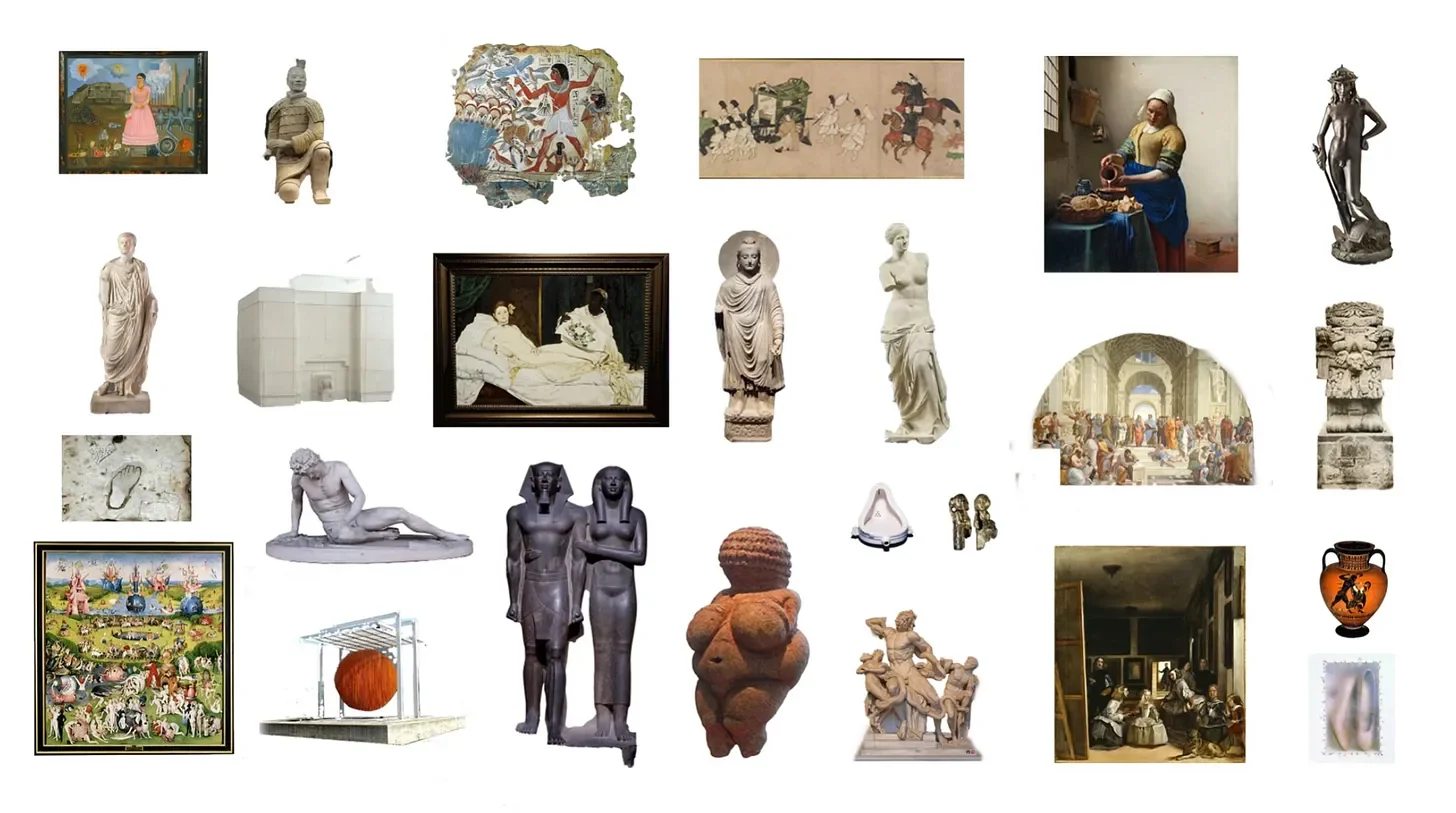
When I started at Wellesley in 2011, I thought architecture, a creative practice grounded in world building, might hold the answers to the questions I was starting to form about space, power, politics, and culture. I continued to explore ways of thinking about objects as texts—texts that tell us about the societies that made them. Texts that we, as designers, have the responsibility to enter into dialogue with and build off of.
With Studio Art Professors Daniela Rivera and Andy Mowbray, I learned how to form the words that were the basis of these texts. I learned how a single line on a surface could carry infinite abstract possibility, or how form could translate movement or sound. By learning to draw with them, I learned a whole new language and way of seeing and understanding the world. I was introduced to the work of artists such as Rachel Whiteread, Donald Judd, Richard Long, and others. Through conversations about their work, I began to glimpse how each act of creation enters into a conversation that stretches across time. Daniela and Andy taught me that our knowledge and our creative practices are never isolated, but always in dialogue with the past, shaped by the present, and reaching toward the future.
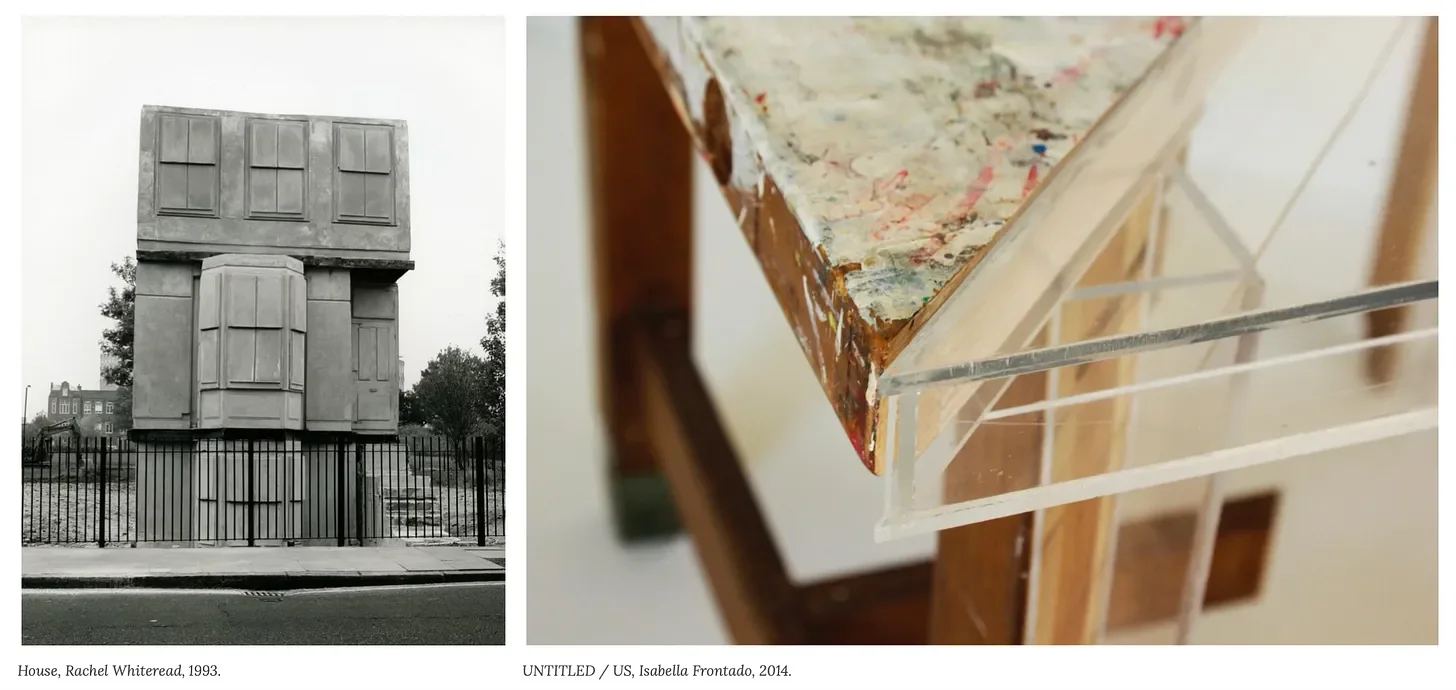
Professor Berman and Professor Cassibry, taught me visual analysis, and helped me to understand and dissect the text and context and to piece together how social, political, and economic transformations left their marks not just in archives but on stone, wood, canvas, or even soil.
One turning point came my senior year, in Alice Friedman and Martha McNamara’s course on Modern Architecture, where we read Beatriz Colomina’s essay “The Lawn at War,” and where I learned that landscapes could also be read as texts. On the surface, the lawn seemed innocuous—just a patch of green in front of a house, part of the everyday backdrop of suburban American life. Colomina argued that the lawn is not neutral at all; it is one of the most highly coded and political landscapes in American culture. A stretch of grass was a microcosm of American identity—an artifact of 20th century power, consumption, exclusion, and aspiration. That realization—that landscapes we take for granted are in fact instruments of ideology—has never left me. It reframed how I looked at every place: not as passive scenery, but as a site where values are inscribed, contested, and lived.
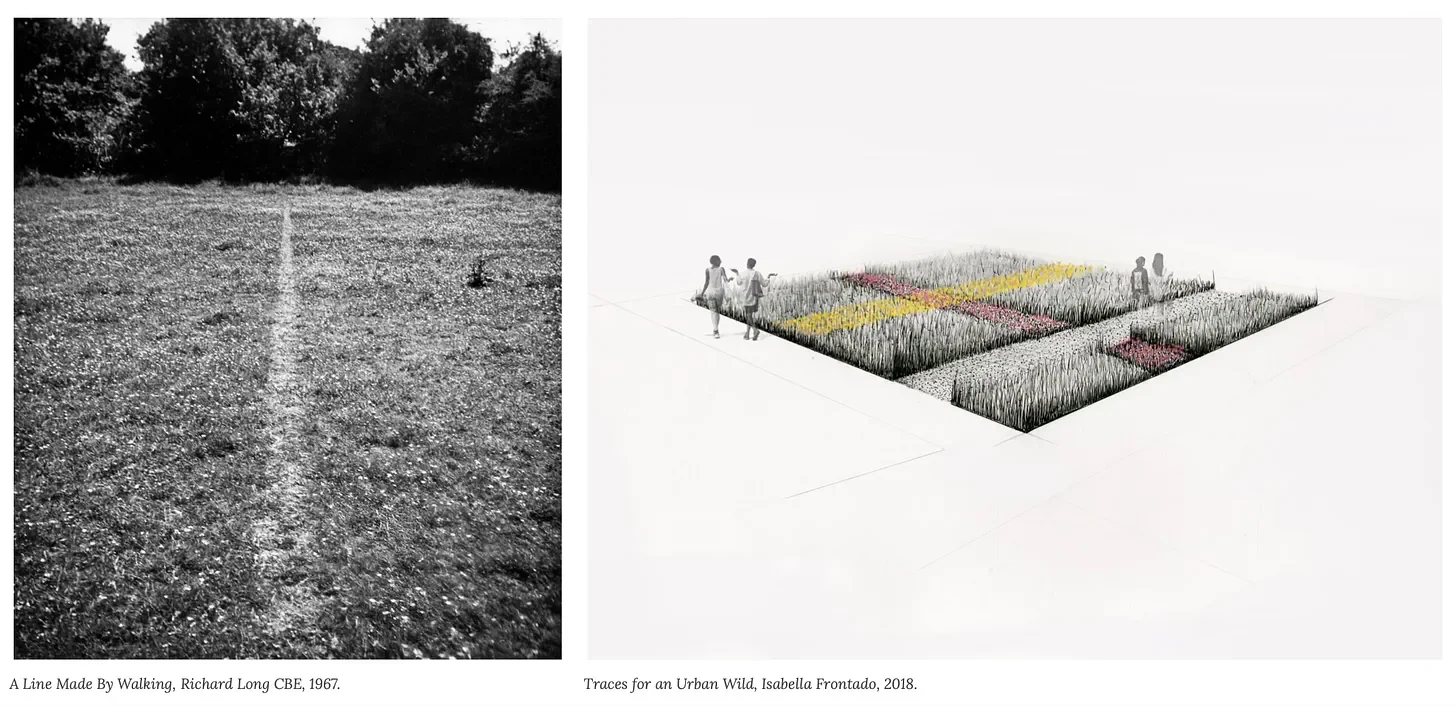
Anne Whiston Spirn’s course at MIT, The Once and Future City, expanded my understanding of landscape, and I learned how to read a living system. I began to see how landscape architecture itself could be a framework for uniting design, ecology, and community. Spirn challenged us to look beyond the surface of the built environment and to recognize that cities are not separate from nature, but expressions of it—shaped by geology, hydrology, climate, and culture. Drawing from her book, The Granite Garden, she showed how every street, park, and building is also part of a larger ecological system, and how the health of those systems directly shapes the lives of people who inhabit them. What struck me most was her ability to read the landscape and unpack how the past is still inscribed into land. Her belief was that by learning how to read the landscape, our new interventions might better support the creation of more just, resilient, and democratic communities.
When I think about Wellesley’s charge to us—to make a difference in the world—I see my education at Wellesley as having given us the tools to read the world and to situate ourselves in the context of it all so that we could see the world more expansively and understand what difference we needed to make in it. Landscape is for me the field where that charge to make a difference in the world becomes concrete. Because to shape a landscape is to shape how people move, how they gather, and how they live.
Landscape as a Celebration of Change and Loss
After graduating from Wellesley, thank you to Wellesley alums Gina Ford and Alex Toteva, I interned for a year at Sasaki, as an Urban Designer. While there, I sat just behind Diana Fernandez, my mentor and boss today. The conversations I had and the sheer range of projects I saw at Sasaki, confirmed for me that landscape was the scale I wanted to work at: attentive to design, but expansive enough to embrace social, ecological, and political systems.
That path took me to Harvard’s Graduate School of Design, where I pursued both a Master in Landscape Architecture and a Master in Design Studies focused on Art, Design, and the Public Domain. I was drawn to landscape architecture because it celebrated the inevitability of change, while architecture so often seemed to resist it—controlling every line, angle, and plane as if it could cement itself in history forever. Landscape, by contrast, treated change not as failure but as a condition to be worked with.
That perspective resonated deeply with me on a personal level. To be Venezuelan American is to live with the understanding of inevitable change and loss. I carry with me not only memories of family and place, but also the weight of absence—streets emptied, houses abandoned, towns reduced to shells of what they once were. A country can vanish not all at once, but piece by piece, hollowed by crisis until what remains are fragments, echoes, and ghosts. That loss imprints itself on you, teaching you that nations, like landscapes, are fragile: they can be eroded, dismantled, or left behind. I found in landscape a way of thinking about change as something to be designed and a process to be choreographed.
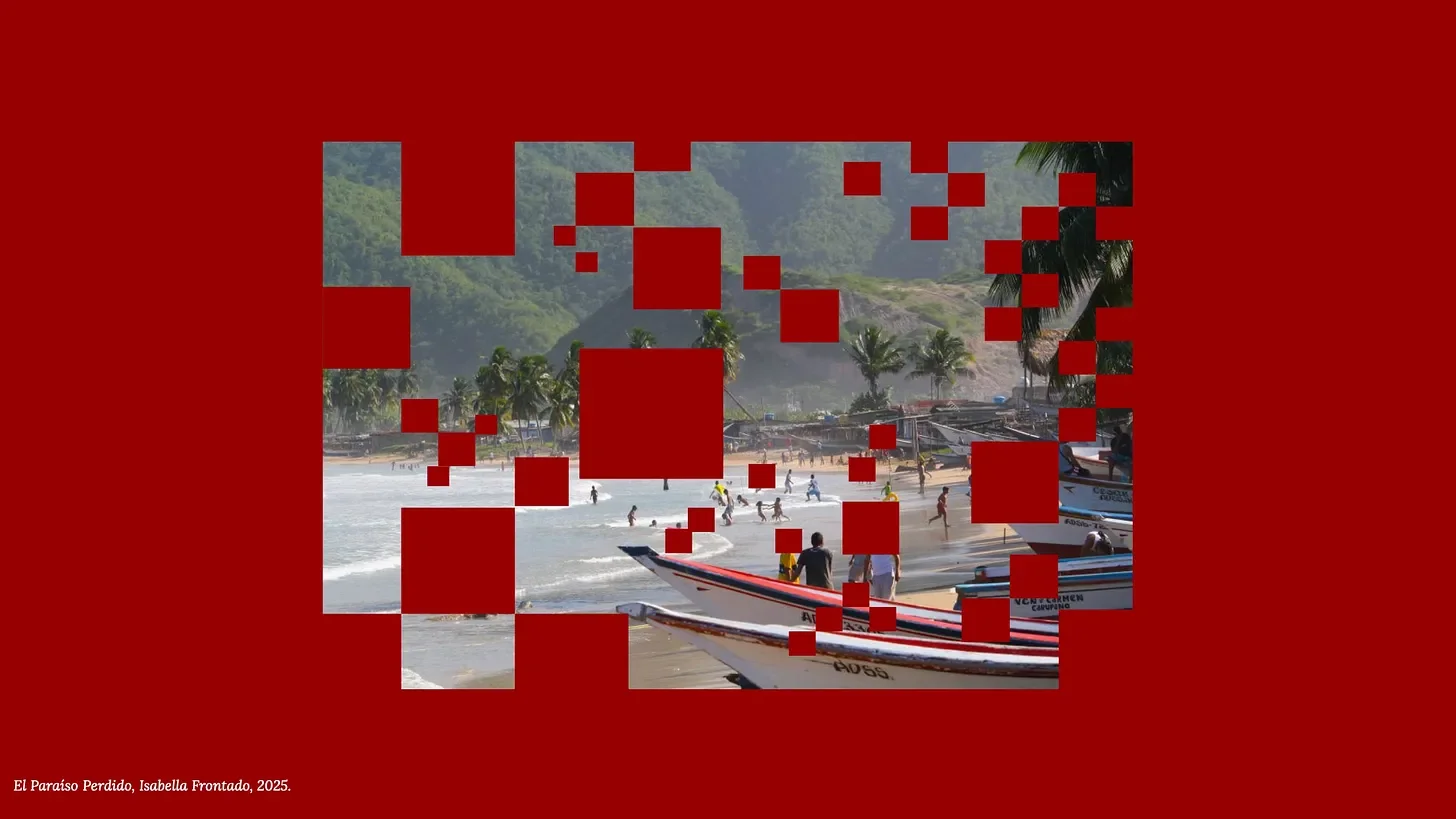
It was from this intersection—between my personal experience of loss and my academic study of change—that my work at the GSD took shape. I turned toward questions of erosion, loss, and erasure in the face of a changing climate. I became fascinated by how private land ownership—so deeply rooted in the foundation of American identity—has shaped and defined our landscapes. Walled, fenced, marked, and measured, the American landscape has long been commodified. Yet this notion of land as property depends on its relative stability, a quality that climate change and sea-level rise are actively eroding. For many coastal communities, as land disappears, the only formal trace of once-inhabited ground will be the property deed—an inherently American document that transforms earth into an object of trade and consumption.
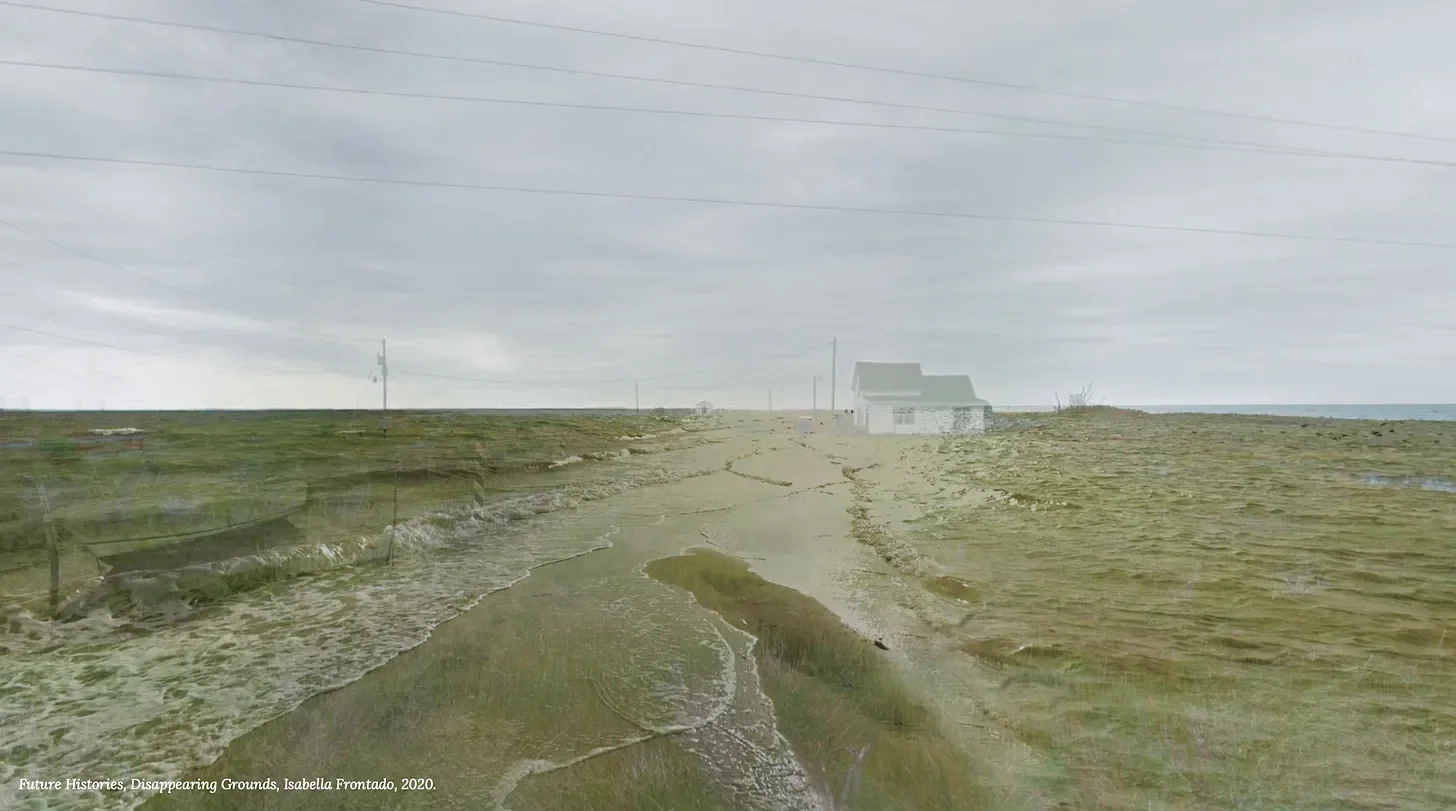
Through my graduate thesis, Future Histories: Disappeared Ground, I studied Tangier Island, Virginia, a community in the Chesapeake Bay where land is literally slipping into the sea. The people of Tangier are deeply rooted in this place. Their isolated community reaches back to the island’s 18th-century colonial settlement of the Chesapeake, and they carry with them an accent and traditions that descend directly from those first arrivals. They have become a people whose cultural continuity, knowledge of tides and soils, and ways of life are tied to the bay and make them inseparable from it. For them, this is not a second or third home that can be abandoned when the tide rises; it is their only home, bound up with their history, identity, and way of life. I recorded how residents use signs, symbols, and everyday acts of landscape maintenance to inscribe and re-inscribe their relationship to land. A fence, a rope, a buoy—on the surface these gestures are small, but together they preserve memory, mark belonging, and maintain the idea of land as something stable, even as the ground beneath dissolves. These practices are cultural and political inscriptions. They are drawing. They are the act of creating a mark on the ground and writing a place into the landscape.
City Practice Now
Today, in my work with the City of Boston, I find myself returning to these same questions of inscription and care for a place—though in very different contexts. Whether it is through conversations with city residents asking them what makes a park feel public or through collaborative efforts to expand our network of publicly accessible open spaces, the work of landscape design is always entangled with politics and democracy. Every new plan, every design study, every zoning change, every investment in the public realm is a kind of drawing—a line traced across the city that expands access, belonging, and our collective imagination of the future. My colleagues and I often talk about public engagement as an act not of presentation, but of co-creation: a chance to educate residents on design and allow them the opportunity to leave their own marks on the city’s evolving story.
I came to the City because I wanted to be the patron. In the long arc of history, designers have always been bound by the vision—and the limits—of their patrons. Sick of designing paving patterns and water fountains for people’s backyards, I wanted to sit on the other side of that relationship, to help create the conditions where more visionary, more just, more democratic work could be possible. My role now is not only to design, but to make space for design: to ensure that the marks we inscribe on this city reflect not just the power of a few, but the imagination of the many.
In many ways, I see this work as a continuation of what first struck me in Venezuela, what I studied at Tangier, and what I learned at Wellesley—that landscapes are living records. They are not just physical places but social texts, written and rewritten by policy, by memory, by cultural practice. To work as a designer in a civic setting is to become a steward of those texts, to hold open the space where many hands can draw together on the same ground.
Politics / Democracy / Drawing
If there is one through-line in my journey, it is that drawing—whether on paper or on the ground—is always a political act. To draw is to inscribe a vision of the world, to claim a place, to mark a boundary or open a possibility. Democracies, like landscapes, are sustained not by monuments or master plans, but by countless small marks: the ballot cast, the meeting convened, the fence mended, the line sketched in dialogue with a neighbor. Each is fragile, but together they hold the possibility of resilience and renewal.
As designers, we are called to recognize that the lines we draw shape how people live, move, gather, and belong. We inherit layers inscribed before us, and we add our own. And if we are attentive—if we understand design not only as artistry but as civic work—then perhaps our work can help sustain the fragile, unfinished project of democracy itself.